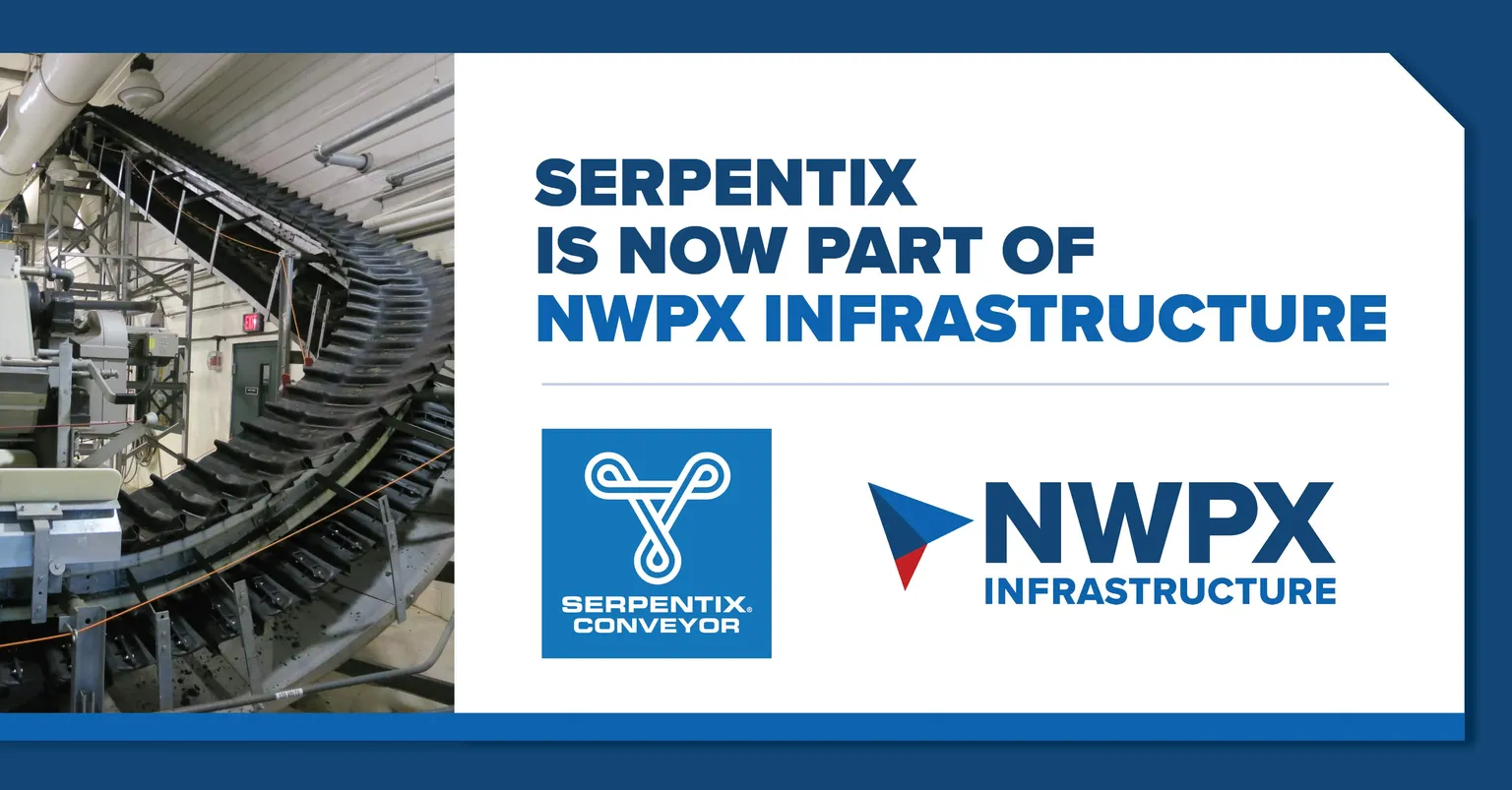
Ask a maintenance supervisor where their conveyor problems live and the answer is usually the same: at the transfer points. Conventional straight conveyors force a transfer at every change of direction or elevation — and each one brings a drive, a chute, a spill zone, a dust source, and a standing maintenance item. The layout, not the conveyors, creates most of the workload.
What a Multi-Conveyor Layout Really Costs
A typical dewatering-to-loadout path with two direction changes means three conveyors, two transfer towers, three drives, three sets of electrical, and two chutes that plug on wet days. Beyond capital cost: three machines to maintain, two spill points to clean, and a failure probability that compounds — any one machine down stops the train.
The Serpentine Alternative
The Pathwinder conveyor follows the path instead of demanding straight lines: it turns through a 6-foot radius, climbs and descends at up to 45 degrees, and does it as one continuous belt with one drive. The transfer points simply don’t exist. That single fact cascades through the economics:
- One drive and one electrical feed instead of several
- No transfer chutes to plug, wear, or spill
- One machine on the PM schedule
- A materially smaller footprint, since the route can wrap around existing equipment and structure instead of forcing a straight-line corridor through the building
Where discharge flexibility is needed, the Flex-End Discharge accessory adds multiple discharge points across a 12-foot arc — still without a second conveyor.
When Consolidation Isn’t the Answer
Long, straight, high-tonnage runs remain the natural territory of conventional heavy-duty machines like the Model-H conveyor, and some layouts genuinely need distribution capability at the end of the line, which is the Flight Distribution conveyor’s job. The point isn’t that one machine fits everything — it’s that transfer points should exist by decision, not by default.
If your material path includes transfers that exist only because conveyors couldn’t turn, that’s a layout worth re-examining. Submit it through the Serpentix free engineering review and our engineers will show you what a consolidated route through your actual building looks like.
Title: Integrating Conveyors With Plant Automation: Sensors, Interlocks, and Smarter Material Handling Meta description: Modern conveyor systems are controls projects as much as mechanical ones. What automation integration looks like for wastewater conveyors — and what it does for reliability. Image: [INSERT IMAGE URL]
Integrating Conveyors With Plant Automation: Sensors, Interlocks, and Smarter Material Handling
A conveyor that only knows “on” and “off” makes the plant work around it. Modern treatment facilities run on SCADA, and material handling belongs inside that picture — sequenced with the process, protected by interlocks, and visible to operators the way every other unit process is.
What Integrated Conveyor Controls Actually Do
- Process sequencing: conveyors start ahead of dewatering equipment and stop after lines clear, automatically — no operator round trips, no material dumped on a stopped belt
- Train interlocks: a downstream stop halts upstream feed instantly, so a fault means a stopped system rather than a buried transfer point or an overloaded discharge
- Condition monitoring: belt tracking, drive load, speed sensing, and plug detection feed alarms that catch developing problems while they’re still scheduled-maintenance items
- Load-out automation: distribution systems like the Flight Distribution conveyor sequence their distribution cycle automatically, turning truck loading into a supervised rather than operated task
- Operator visibility: run status, faults, and interlock states on the same screens as the rest of the plant
Why Integration Beats Bolt-On Controls
Controls added after the mechanical design tend to automate the machine as built, quirks included. Designing the two together — the machine and its automation — means sensor placement, drive selection, and control logic reflect how the system should behave in the process, not just how it moves. Serpentix designs both sides in-house, so the conveyor arrives with controls engineered for it rather than adapted to it.
Retrofit Integration Is Worth It Too
Existing conveyors can usually be brought into SCADA with drive upgrades, sensing, and interlock work — often the highest-value reliability improvement available for the money, because it converts silent mechanical problems into visible alarms. It also generates the run-time and load data that makes repair-or-replace decisions factual instead of anecdotal.
Whether it’s a new system or bringing a legacy train into the modern controls world, scope the automation with the mechanical work, not after it. Our engineers cover both in a free engineering review — bring your P&IDs and your layout and we’ll look at them together.