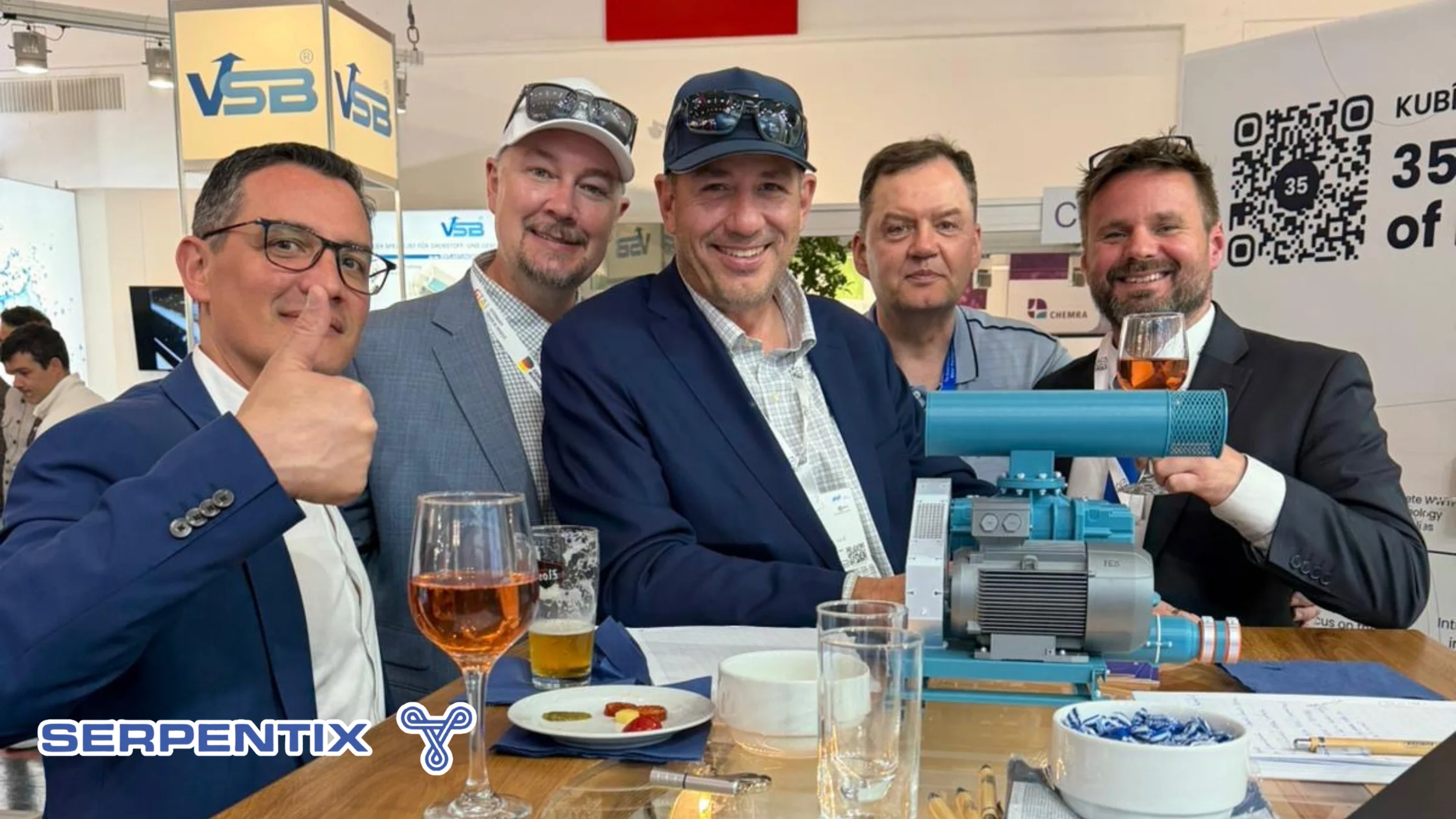
Trade shows at the scale of IFAT Munich are more than an opportunity to exhibit. When your booth is drawing professionals from 14 countries over four consecutive days at full venue capacity, you come away with a real picture of what facilities around the world are dealing with. Here’s what stood out from our time on the floor.
Facility Constraints Are Universal
Whether the conversation was with an operations manager from Germany, a project engineer from Korea, or a municipal procurement contact from Brazil, the underlying challenges were consistent: limited footprint, continuous operation requirements, difficult material characteristics, and pressure to reduce long-term maintenance costs.
These aren’t uniquely American problems. The Pathwinder’s 6-foot radius and 45-degree incline capacity is specifically designed for facilities where conventional straight-line conveyors don’t fit the site. The Model-H, built for high-speed, high-volume 24/7 operations, maps directly to the continuous operation requirements that treatment plants worldwide can’t compromise on. Both generated consistent interest from attendees across very different geographic and regulatory contexts.
Live Demos Still Close Conversations
We ran product demonstrations throughout all four days of the show. Seeing conveyor components in motion — understanding how the flight system works, how the system handles material at the discharge point, what maintenance access actually looks like — moved conversations further than any specification sheet could.
The engineers in the room at IFAT aren’t looking for marketing. They’re evaluating whether a product will work in their plant. A live demo answers that question faster and more credibly than a brochure.
The Market Is Growing and Technical Buyers Are Informed
Attendance was at full capacity each day across 18 indoor halls and a large outdoor area for heavy equipment and vehicles. The show draws a serious audience — procurement teams, facility engineers, and municipal project managers who come prepared with specific technical questions.
That level of buyer sophistication reflects a market that is actively investing in infrastructure. Facilities modernizing their solids handling systems want to understand what they’re buying, not just what it costs. Being able to engage at that technical level — discussing drive sizing, material characteristics, discharge flexibility options like the Flight Distribution conveyor and the Flex-End Discharge — is where Serpentix’s engineering-first approach has a real advantage.
What Comes Next
The conversations started at IFAT are the beginning, not the outcome. Following up on new international contacts, providing engineering reviews for specific project requirements, and building relationships with representatives who can support facilities in their region — that’s the work that turns a trade show into actual business.
If you met us at IFAT and want to continue the conversation, or if you’re evaluating conveyor systems for a water or wastewater application anywhere in the world, contact our team directly or request a formal quote. Our engineers work through your specific requirements before any proposal goes out. Learn more about who we are and how we work.