Off-the-shelf conveyor equipment has a clear role in industrial operations — standard applications with predictable materials and consistent site conditions can often be served well by catalog products. But there’s a broad range of applications where standard equipment doesn’t perform adequately, and where the economics of repeated repairs and workarounds eventually exceed the cost of a system built for the specific application. Here’s how to think about the tradeoffs.
What Off-the-Shelf Equipment Optimizes For
Standard catalog conveyor products are designed to cover a wide range of applications at the lowest possible unit cost. They’re built to handle typical materials at typical speeds in typical site conditions. The tradeoffs — standard component sizes, limited geometry options, materials and coatings selected for broad compatibility rather than specific conditions — are acceptable in standard applications. In applications outside those parameters, the tradeoffs become problems.
Where Custom Engineering Adds Value
Custom conveyor engineering adds demonstrable value when the application has variables that standard products don’t address:
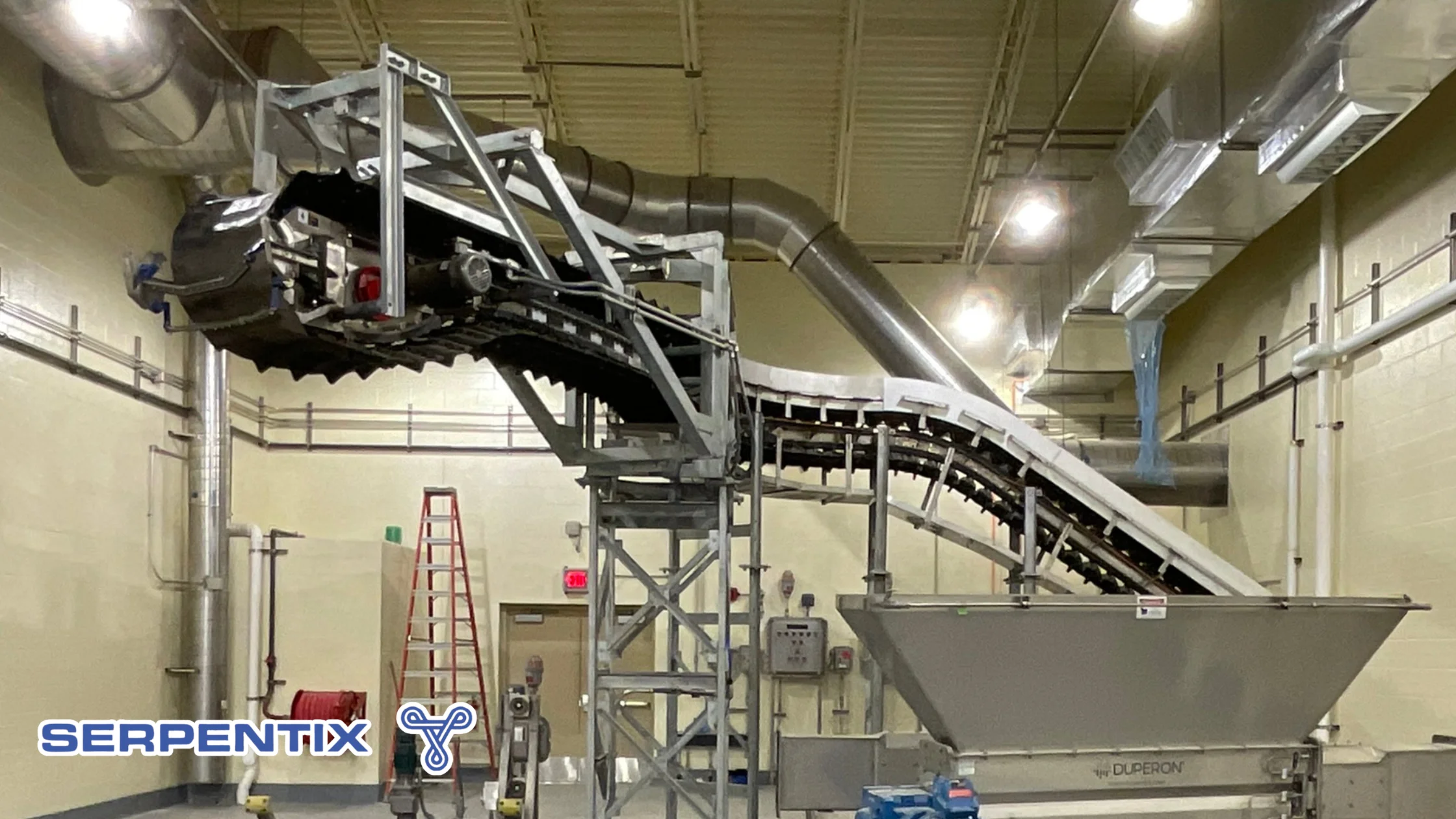
- Unusual site geometry or access constraints — the Pathwinder’s 6-foot radius and 45-degree incline capacity is designed specifically for this, replacing multiple straight-line conveyors with a single unit that navigates the actual facility layout
- Facilities with multiple discharge requirements where a single fixed endpoint isn’t sufficient — addressed by the Flight Distribution conveyor or the Flex-End Discharge on Pathwinder systems
- High-volume, continuous 24/7 operations where a lighter-duty standard system will fail to keep pace — the Model-H is built for exactly this profile
- Severe environmental conditions — chemical exposure, high moisture, abrasive materials — where standard coatings and materials degrade faster than the system’s intended service life
In these situations, a system built to the specific requirements of the application performs better, requires less ongoing modification, and costs less to maintain than an adapted off-the-shelf system.
The Total Cost Comparison
The upfront cost comparison between custom and off-the-shelf equipment usually favors the catalog product. The total cost comparison over 10–15 years often goes the other way. A custom system designed for your material, your environment, and your operational constraints typically outperforms an adapted standard system on uptime, maintenance frequency, and service life.
Building a total cost model that includes maintenance labor, unplanned downtime, and expected service life produces a more accurate comparison than a purchase price comparison alone.
When to Specify Custom
The decision point is usually driven by one of a few factors:
- Material handling requirements that standard equipment can’t meet
- Site geometry that requires non-standard dimensions or routing
- Regulatory requirements that mandate specific materials or certifications
- A prior installation of standard equipment that has consistently underperformed
If you’ve been working around the limitations of your current system for more than a year, it’s worth getting a custom engineering assessment.
Serpentix Conveyor Corporation designs and fabricates custom conveyor systems for applications where off-the-shelf equipment isn’t adequate. Our engineering process starts with a site-specific review of material requirements, site conditions, and operational constraints. Contact us to discuss your project.