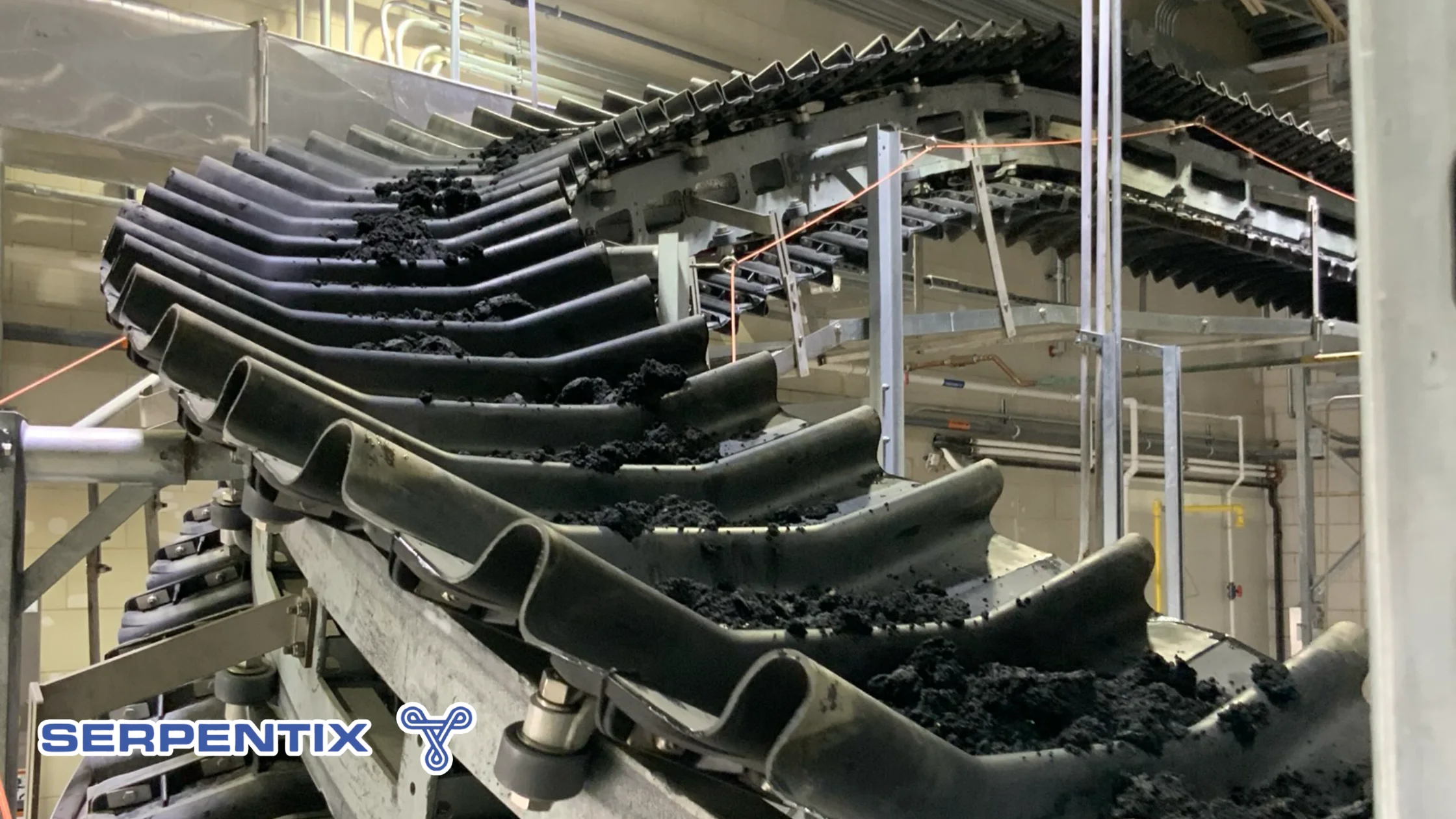
Most wastewater treatment facilities weren’t designed with conveyor routing in mind. Equipment is permanently positioned, floor space is constrained, and the path from a dewatering press to a truck loading area rarely runs in a straight line. Conventional conveyor systems handle this by adding transfer points — one conveyor ends, another begins, material drops between them, and so does your maintenance budget.
The Pathwinder was built to solve this differently. It is Serpentix’s flagship conveyor and our most widely specified system in municipal wastewater treatment — not because it’s the simplest option, but because it fits the actual conditions of the facilities it goes into.
What the Pathwinder Does
The Pathwinder is a continuous-belt conveyor system with patented path capability. A single belt handles horizontal turns, vertical inclines, and helical curves — all within one system, with no transfer points between them.
The practical upshot: one Pathwinder replaces what would otherwise require multiple conventional conveyors. That means fewer motors, fewer gearboxes, fewer maintenance points, and less floor space consumed by equipment transitions.
Key specifications:
- Maximum length: up to 250 feet
- Maximum incline: 45 degrees
- Turning radius: 6 to 18 feet
- Belt widths: 16″, 20″, 26″
- Belt speed: approximately 90 ft/min
- Capacity: up to 300 tons/hour
- Path types: horizontal, vertical, helical, or any combination
Where It Fits
The Pathwinder’s most common application is elevating dewatered sludge from a belt filter press to a truck loading area. The geometry of that path — upward at a steep angle, often turning around fixed equipment — is exactly what the system is engineered for.
Beyond biosolids and sludge, the Pathwinder handles:
- Screenings from bar screens and fine screens in headworks operations, specified with materials and surface treatments for high-moisture, high-wear, and corrosive conditions
- Grit from grit removal systems, configured to match each facility’s throughput volumes, layout, and discharge requirements — among the most abrasive service conditions a conveyor encounters
- Industrial sludge and solids transport in chemical, food processing, pulp and paper, and manufacturing applications
The belt is segmented, which allows straightforward replacement of damaged sections without removing the entire belt. It is also enclosed-capable for weather and odor control — a common requirement in biosolids handling where open conveyors are not permitted.
Why Maintenance Stays Low
The Pathwinder’s drive and tension station has only two bearings — an intentional design decision that minimizes maintenance requirements. The tension station uses two adjustable springs to maintain constant positive pressure on the main drive chain, which means consistent chain engagement without manual adjustment under normal operating conditions.
The chain-driven conveying surface provides positive tracking, eliminating the belt drift and slipping that require intervention on conventional belt systems. For sticky materials like biosolids and sludge cake, a scraper system removes carryback at the drive and tension sprockets where the belt pan convolutions stretch flat — the natural geometry of the system creates the ideal scraping point.
The Flex-End Discharge Option
For facilities where a single fixed discharge location isn’t practical, the Flex-End Discharge is available on Pathwinder systems. It adds multiple discharge points across a 12-foot arc, allowing material to be directed to different locations without structural modification to the facility.
This is the preferred specification when fixed structural discharge points aren’t achievable — older plants where the ceiling or floor configuration won’t accommodate a new fixed point, or facilities that need operational flexibility to direct material to different destinations depending on what’s running.
Retrofits and Existing Facilities
The Pathwinder was specifically developed with retrofits in mind. Its ability to navigate turns and inclines within a 6-foot radius means it can be routed around equipment that’s already in place — interfacing with belt filter presses, centrifuges, loading systems, and storage structures without requiring those to move.
This is what makes it the default specification in existing municipal treatment plants. New construction can be designed around any conveyor. Retrofits have to fit what’s already there, and the Pathwinder’s geometry handles that better than conventional systems.
If you’re evaluating whether the Pathwinder fits your facility’s layout, submit your drawings for a free engineering review. Our engineers work through the routing, incline, and discharge requirements before any proposal goes out. You can also find your regional representative or contact our team directly to start the conversation.